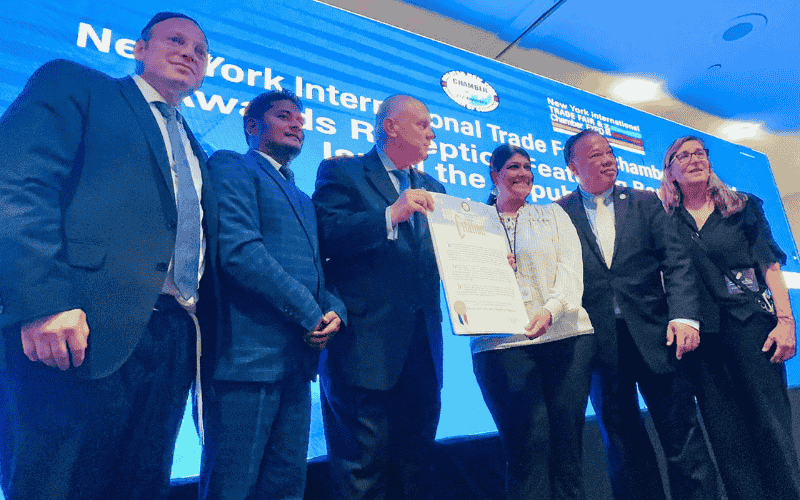
New York International Trade Fair
Creating Economic Opportunities, Shaping a Better Future Together

NewYork International Trade Fair 2026
25th September 2026, Friday,
Marriot Marquis, Times Square
New York, USA
Objectives
NY International Trade Fair Objectives
- To build the “New Bangladesh” brand image by rewriting the narrative of Bangladesh, painting a vivid picture of its rich culture, dynamic industry and limitless potential.
- Unveiling new avenues of growth for Bangladeshi industry and showcasing the spirit of innovation that drives our production and manufacturing sector
- Facilitating effective networking, dialogue and partnership opportunities among investors, policy makers and wider groups of stakeholders.
- To foster a culture of NRB involvement and contribution to the nation’s development efforts and reconnect them with their roots.
BANGLADESH
The Rising Star of Asia
One of the world’s fastest-growing Economies
Bangladesh, growing rapidly over a decade, is on its way to becoming the next Asian Tiger. The country’s economy has grown at an average rate of 6– % per year over the past decade. Currently the 35th largest economy, Bangladesh is projected to rise to the 25th largest by 2035.
Connecting large consumer markets
Bangladesh’s consumer market is set to grow over 7% annually, positioning it as the 9th largest consumer market by 2030. Besides being the location for a booming domestic market, Bangladesh is also strategic hub linking India, China and the ASEAN countries.
Connecting large consumer markets
Bangladesh is powered by a rising young population. Young Bangladeshis are fuelling a sharp rise in the labor force and supporting industrialization and consumption. 45% of its population is aged below 24 years, 70% is aged below 40 and 2.3 million young professionals enter workforce every year.
Empowering infrastructure
Bangladesh’s strategic infrastructure developments are accelerating industrial growth. 580 km coastline with 3 sea ports Chittagong, Mongla, and Payra, 10 active land ports are linking various states of neighboring India, 3 international & 5 domestic airports. 3 Asian highways- AH1, AH2 and AH41 connecting India & Myanmar, Part of regional highway corridors like SASEC, BIMSTEC and SAARC etc.
Padma Bridge, Metro rail, Dhaka Elevated Expressway, the third terminal of the Hazrat Shahjalal International Airport are already in operation and deep-sea ports – Matarbari and Payra Ports are expected to be completed by 2025.
Investment focus
Bangladesh has the most liberal investment regime in the region, characterized by a wide array of facilities, attractive incentive policies and consistent reforms. In 2019, the country became a top-20 improver of the World Bank’s Doing Business Index.
Towards A Sustainable and Green Bangladesh
Bangladesh is committed to sustainable development with a focus to environmental preservation and sustainable economic growth. Bangladesh now has world-highest 183 green apparel factories. The country aims to generate 15 per cent of electricity from renewables by 2030, 40 per cent by 2050. Bangladesh aims at reducing 30% plastic waste by 2030 and committed to cut carbon emission by 22% within 2030.